


How Many Yards of Fabric Do You Need for a Maxi Dress?
A maxi dress generally requires about 2½ to 4 yards of fabric, but that range is only a starting point. A simple sleeveless design made from 60-inch-wide fabric may need around 2½ to 3 yards, while a long-sleeved, gathered, tiered, or very full design may require 4 yards or considerably more.
Fabric width, pattern size, skirt volume, sleeves, print direction, and the intended hem length all affect the final calculation. If you are using a commercial sewing pattern, its yardage chart should take priority over a general estimate.
Estimate the Fabric Needed for a Maxi Dress
Use 2½ to 4 Yards as a General Starting Range
For many adult maxi dresses, the following estimates provide a practical starting point:
These are planning ranges rather than guaranteed requirements. The same amount of fabric will not work for every sewing pattern or body measurement.
Before buying material, decide what “maxi” means for the design you intend to make. A maxi dress may finish at the ankle, cover the top of the foot, or fall close to the floor. The guide to what defines a maxi dress explains how this length differs from the dress’s silhouette and level of formality.
Adjust the Estimate for 45-Inch or 60-Inch Fabric
Fabric is commonly sold in different widths, and width changes how efficiently the pattern pieces can be arranged.
A 60-inch-wide fabric usually allows more bodice, sleeve, and skirt pieces to sit beside one another. A 45-inch-wide fabric often requires the same pieces to be arranged one below another, increasing the number of yards needed.
For example, a simple A-line maxi dress that uses approximately 3 yards of 60-inch fabric might require closer to 4 yards when cut from 45-inch fabric. This is not a reliable conversion formula, however. Wide skirt panels, large sleeves, or unusual pattern pieces may not fit beside one another even on wider material.
Simplicity’s guide to understanding the pattern envelope confirms that garments made from 45-inch fabric generally require more yardage than the same garments made from 60-inch fabric. Use the yardage entry that matches both your pattern size and the actual usable width of your chosen material.

Allow Extra Fabric for Larger Pattern Sizes and Tall Lengths
Larger pattern sizes may require additional fabric because the bodice, sleeves, and skirt panels occupy more width. The increase is not always consistent: several adjacent sizes may share one yardage figure, followed by a larger increase when the pieces no longer fit within the same cutting layout.
Additional height can also affect the estimate. If you lengthen a dress by three inches, you cannot always add only three inches of fabric. A maxi dress may contain several skirt panels, tiers, ruffles, or a separate lining, and each affected piece needs to be lengthened.
Use the sewing pattern’s measurement chart rather than your usual ready-to-wear size. If you are comparing the finished proportions with a purchased dress, the Rich Radiqs dress size and model guide is a useful reminder that product-specific measurements should take priority over the size label alone.
Account for the Maxi Dress Design
Add Fabric for Full, Pleated, or Tiered Skirts
Skirt volume is often the largest variable in maxi dress yardage.
A straight or gently flared skirt can sometimes be cut from two relatively narrow panels. A gathered skirt needs extra width so the fabric can be drawn into the waist. Circle skirts, deep pleats, and multiple tiers require still more material because their volume is built into the pattern pieces.
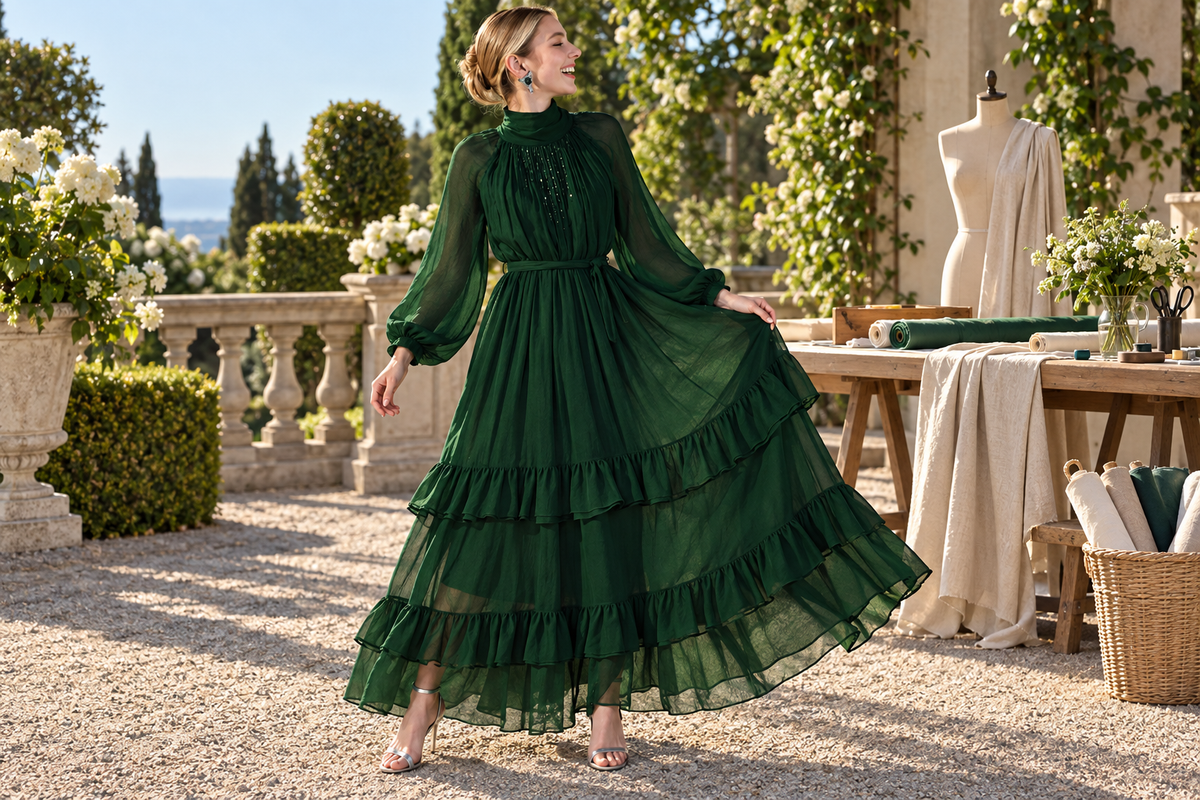
A tiered maxi dress may use several long strips of increasing width. Even when each tier appears simple, the combined length can raise the requirement well beyond the standard 2½-to-4-yard range.
Silhouette is therefore more useful than the word “maxi” when estimating fabric. Browse the current Rich Radiqs maxi dress collection to compare how straight, A-line, tiered, pleated, and relaxed long dresses distribute fabric differently. The collection provides visual references, but it does not establish yardage for recreating a particular garment.
Consider Sleeves, Trains, Ruffles, and Matching Belts
Every added component occupies space in the cutting layout. Possible additions include:
- Short, three-quarter, or long sleeves
- Wide cuffs
- Ruffles or flounces
- A train or high-low hem
- A matching belt or sash
- Pockets
- Collars and facings
- An overlay or separate lining
Long sleeves may require approximately ½ to 1 additional yard, depending on their width and the remaining space in the layout. Full sleeves, large ruffles, and trains can require more.
Lining must usually be calculated separately. A fitted bodice lining may need relatively little material, while a fully lined maxi dress may need nearly the same length as the outer dress. Do not assume that the outer-fabric yardage includes the lining unless the pattern specifically states that it does.
If you are deciding whether your design should be midi or maxi before purchasing fabric, the midi-versus-maxi dress comparison can help clarify the difference in coverage and overall proportions.

Allow Extra Yardage for Prints, Nap, or Directional Fabrics
A solid fabric without a directional surface allows pattern pieces to be rotated when the grainline and pattern instructions permit. Directional prints, stripes, plaids, velvet, corduroy, and fabrics with a noticeable nap provide less flexibility.
All major garment pieces may need to face the same direction so the print, surface texture, or reflected color remains consistent. Pattern matching can also require pieces to shift along the fabric until motifs or stripes align across seams.
The Sewing and Craft Alliance’s guidance on working with napped fabrics notes that one-direction layouts generally require extra material. If the fabric is expensive, test the complete layout on paper, muslin, or a measured floor area before purchasing.
For a large print, buying at least one additional pattern repeat is a reasonable starting allowance. More may be necessary when the dress has a center-front seam, multiple skirt panels, pockets, or a button placket that must align.
Calculate Fabric Yardage Before Cutting
Measure the Pattern Pieces and Compare Them With Fabric Width
The most reliable calculation comes from arranging the actual pattern pieces within the usable fabric width.
Use this process:
- Complete all length and fit adjustments on the paper pattern.
- Record the fabric’s usable width between the selvages.
- Mark that width on a large table, floor, or sheet of paper.
- Arrange every pattern piece according to its grainline and cutting instructions.
- Keep all pieces facing one direction if the fabric has nap or a directional print.
- Measure the total length occupied by the layout.
- Add any appropriate allowance for shrinkage, pattern matching, or cutting errors.
- Divide the total inches by 36 to convert the measurement to yards.
For example, if the finished layout occupies 117 inches, divide 117 by 36. The result is 3.25 yards, so you would need at least 3¼ yards before adding any project-specific allowance.
Complete this trial layout with the correct pattern size. Changing the size after buying the fabric may change the amount required.
Follow the Yardage Chart on the Sewing Pattern
A commercial pattern normally lists fabric requirements by:
- Design view
- Pattern size
- Fabric width
- With-nap or without-nap layout
- Main fabric, lining, and contrast fabric
Locate the row for the version of the dress you are making, then follow the column for your pattern size and fabric width. Do not combine the yardage for one size with the cutting layout for another.
Read the notes carefully. The chart may give separate requirements for a sleeveless version, a long-sleeved version, or an optional train. It may also exclude interfacing, lining, or contrast pieces from the main-fabric total.
When the instructions and your own estimate differ, use the pattern requirement unless you have completed a full-scale layout that proves another amount will work.

Purchase a Small Extra Allowance for Shrinkage and Cutting Errors
An extra ¼ to ½ yard can be useful for a straightforward solid-color dress, particularly when the fabric may shrink or the layout is tight. This allowance is not universal.
Consider buying more when:
- The fabric has a large directional motif
- Plaids or stripes must match
- The material has nap or one-way shine
- The dress contains several tiers or ruffles
- You are lengthening several pattern pieces
- The fabric is likely to shrink during approved pre-treatment
- The same fabric may be unavailable later
Follow the manufacturer’s care directions when pre-treating fabric. Do not wash, steam, or dry-clean material simply because a general sewing guide recommends it; fiber content, weave, finish, and intended garment care all matter.
If the project is primarily inspired by an existing silhouette rather than a commercial pattern, examine several structures in the broader Rich Radiqs dress collection, then draft and test a proper pattern before buying the final fabric. Product photographs alone cannot reveal exact yardage, internal construction, seam allowances, or cutting layout.
Conclusion
Most maxi dresses require approximately 2½ to 4 yards of fabric, but fuller, sleeved, tiered, lined, or train-bearing designs may need 4 to 7 yards or more. Fabric width is equally important: a dress that fits efficiently on 60-inch fabric may require substantially more material at a 45-inch width.
The safest calculation is to adjust the pattern first, select the correct size and design view, and test every piece within the fabric’s usable width. Treat a general yardage range as a budgeting tool—not as a substitute for the pattern layout.


Leave a comment
This site is protected by hCaptcha and the hCaptcha Privacy Policy and Terms of Service apply.